National Treasure

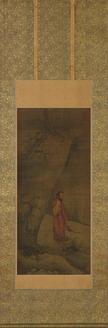
Snowy Landscape
雪景山水図軸
Paintings · Kamakura, 13th centuryTNM
Home › Browse › Paintings › Kamakura period › Detached Segment of Illustrated Scroll of Diary of Lady Murasaki

Murasaki Shikibu was the author of The Tale of Genji, said to be the pinnacle of ancient Japanese literature. This is a segment from an illustrated-scroll version of her diary. Lady Murasaki served as lady-in-waiting to Empress Shoshi. The diary recounts in detail the events of the years surrounding the birth of Prince Atsuhira, the son of the Empress and Emperor Ichijo. It describes the scene of the Prince's birth, for example, and the ceremony to celebrate his birth that took place thereafter. As well as its literary merit, this work is also valuable for what it reveals about the lives of the nobility during the Heian period, which lasted from 794 to 1192. This segment was mounted on a hanging scroll. It depicts a ceremony celebrating 50 days since the birth of Prince Atsuhira. The woman with her back to us on the right side of the scroll is Empress Shoshi.
The man at the bottom of the picture is her father, Fujiwara no Michinaga, a great power in the imperial court at that time. To the left is his wife and Shoshi's mother, who is cradling the infant prince as he approaches his 50th day on earth. Incidentally, this scroll was painted during the Kamakura period, over 200 years from Lady Murasaki's day. Though this may seem like a traditional Heian-period yamato-e painting with its conventional representations of human figures, if you look closer you notice the individuality and distinct features of each person. This sense of expression is typical of the Kamakura period, an age that cherished realism. Michinaga is also sporting a straight-cut garment that was popular during the Kamakura period. It could be fair to describe this as a courtly illustrated scroll altered to reflect the tastes of the Kamakura period.
— Museum description: Tokyo National Museum (CC BY 4.0), via ColBase / Japan Search.