National Treasure

Part of the "Sutra on the Wise and Foolish" (Called "Ōjōmu")
賢愚経残巻(大聖武)
Calligraphy & Books · Nara, 8th centuryTNM
Home › Browse › Calligraphy & Books › Nara period › Volume 2 of the Tōmoku Bosatsu Sutra (Kibi no Yuri's Votive Sutra)
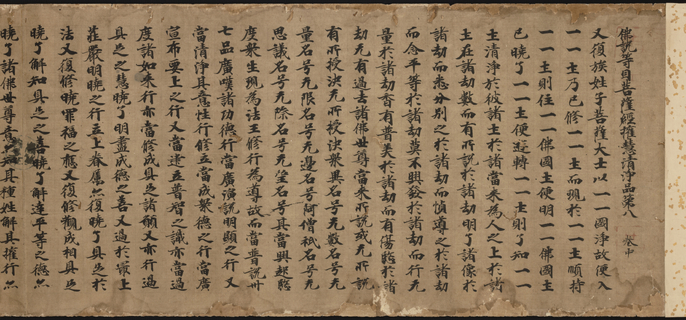
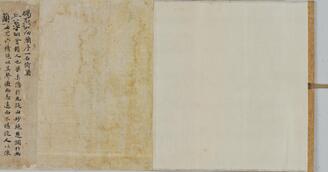
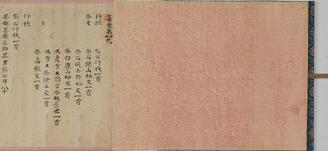
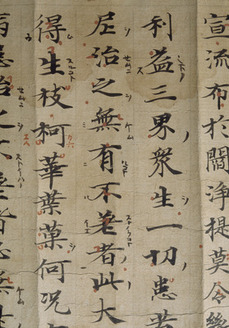
Kibi no Yuri was a lady-in-waiting to the 8th century ruler Empress Shotoku. This volume from a set of Buddhist sutras was transcribed by Kibi no Yuri for the Empress. With its imposing black characters copied out in a rich calligraphic style, it's a prime example of sutra transcriptions from the late Nara period. It's also an example of a complete set of sutras containing the teachings of Shakyamuni, the founder of Buddhism. This one originally contained 5,282 volumes. Another famous Nara period set is the Sutra of the First Day of the Fifth Month, a work commissioned by the Empress Komyo to commemorate her parents' death. This involved the transcription of 4,000 scrolls over a four-year period. Yuri's set also probably took at least five years to complete. At the end of this scroll, it says the work was commissioned by Kibi no Yuri for the Empress on October 8th, 766.
It is thought that Kibi no Yuri was related to Kibi no Makibi, a scholar and politician of the same period. Makibi is known to many from the Picture Scroll of Minister Kibi's Trip to China. It depicts Makibi's wondrous adventures when he travelled to China as an envoy. In fact, 766 was also the year Makibi became Minister of the Right, or Junior Minister of State. Yuri may well have commissioned this work to celebrate Makibi's appointment. Yuri was particularly well-trusted by Empress Shotoku. When the Empress fell fatally ill, it is said Yuri was the only person to attend to her in the 100 days or so before her death in August, 770. The powerful calligraphy of this scroll, with thick brushstrokes full of movement and vigor, make it one of the finest Buddhist sutras transcribed in 8th-century Japan.
— Museum description: Tokyo National Museum (CC BY 4.0), via ColBase / Japan Search.