National Treasure

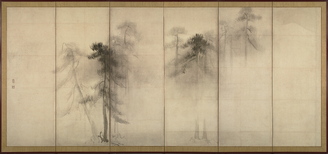
Cypress Trees
檜図屏風
Paintings · Azuchi-Momoyama, 1590TNM
Home › Browse › Paintings › Azuchi-Momoyama period › The Sound of Water from the Bamboo Grove

In the upper right corner of the painting is an excerpt from a Chinese poem composed by the artist Li Shida in the 8th century, during the Tang dynasty. The poem speaks of a beautiful spring landscape where flowers bloom on trees visible through clouds and mist, where a waterfall flows beyond a grove of bamboo, and the sound of falling water can be heard. The name of this painting is drawn from the poem. Within the painting, bamboo groves sprout thickly, and are blown about by the breeze. Further behind, peach flowers in full bloom can be seen, with white flowing mist visible beyond. The two people seated in the foreground seem almost to have their ears cocked to hear the rustling of the bamboo leaves, and the bubbling flow of water in the stream, as well as the sound of the waterfall visible in the mountains beyond.
They must also be able to smell the sweet scent of the peach blossoms. One of the servant children is carrying a zither, and another is drawing water to prepare tea, suggesting a refined banquet that is to follow. This kind of painting, where the poem and painting are enjoyed together, became popular in the 16th and 17th centuries. Li Shida was one of the artists skilled in this style. The rounded and gentle shape of the figures, and the deep perspective possibly borrowed from Western art, are especially well-regarded elements of this painting. Two scholars are enthralled by the sound of the running spring in a bamboo grove while their servants boil tea. In this painting, the artist Li Shida employed a Western-style linear perspective to create depth along the distant mountain path.
— Museum description: Tokyo National Museum (CC BY 4.0), via ColBase / Japan Search.