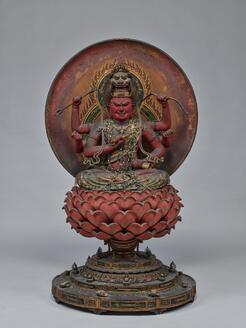
Important Cultural Property

Bodhisattva
菩薩立像
Sculpture · Kamakura, 13th centuryTNM
Home › Browse › Sculpture › Kamakura period › The Buddha Amida with Two Attendants Depicted in the Zenkōji Style

The Buddhist pantheon features numerous deities, each with their own names, appearances, and roles. One of these is Amida Nyorai, or Amitabha in Sanskrit. It was believed that Amida descended to carry the soul of the deceased back to the Pure Land, a realm far to the west of our world. Deities called Buddhas have arrived at the truth, attaining enlightenment. Deities who are training to become Buddhas are known as bodhisattvas. Through the ages, people longed to be reborn in the Pure Land after death, with Amida the most worshipped and revered Buddha in Japan from the 7th century down to the present. This belief led to the creation of many Amida statues. This Amida Triad features Amida and two attendant bodhisattvas. The statues are cast in bronze and gilt. Amida stands in the center. His right elbow is bent and his right hand is held in front of the chest with palm facing outwards and fingers pointing upwards. His left arm hangs straight down with index and middle fingers pointing earthwards. The attendant to the viewer's right wears a crown decorated with an image of a Buddha, while the attendant to the left wears a crown decorated with an image of a jar. From this, we can surmise that the attendants are Kannon Bosatsu, or Avalokitesvara, and Seishi Bosatsu, or Mahasthamaprapta. Both attendants hold their hands in front of their chests with palms pressed one on top of the other. These three deities often feature together as a set in Japan. However, this set differs slightly from other examples when it comes to the positioning of Amida's fingers or the shape of the attendants' hands. This set is believed to be a copy of the Amida Triad that serves as the principal object of worship at Zenkoji temple in Nagano. Zenkoji's Amida Triad is said to have travelled over from the Korean peninsula during the mid-6th century. These secret Buddhist statues have been hidden from the public eye since then, though they are still venerated across Japan.
Reverence for Zenkoji's Amida Triad grew particularly strong around the 11th century, when many people began to worship Amida and pray for rebirth in the Pure Land. At the end of the 12th century, meanwhile, people began to create statues said to be modelled on Zenkoji's Amida Triad, with this trend then spreading across Japan. These copies were made by people who wanted to worship these images, despite the originals being off limits to the public. The copies are said to be made in the “Zenkoji Amida Triad style,” with over 200 examples still existing in Japan today, including this work. Amida Triads usually stand before a decorative halo, so it is thought this Amida Triad also originally came with a halo. The use of gold on bronze and the poses of the deities are characteristic of statues from the 6th to 7th centuries. This museum's Gallery of Horyuji Treasures houses several Buddhist statues from this era, so we invite you to compare them with this triad. The inscription on Amida's back describes how the three deities came with a halo and were modelled on Zenkoji's Amida Triad. It also recounts how they were created in 1254 in Nasu, an area located in modern-day Tochigi prefecture. The history of Japanese Buddhist sculpture is replete with examples of venerable statues becoming objects of worship and then inspiring numerous copies. The Zenkoji Amida Triad probably provides the best example of this tradition. This statue depicts Amida, a Buddhist deity believed to guide the faithful to paradise after death. According to legend, a statue of Amida was brought to Japan from India, the homeland of Buddhism. Because of its sacred power, the statue was hidden from view at Zenkōji Temple in Nagano. As many people desired to worship it, numerous copies were created, with this one dating to 1254.
— Museum description: Tokyo National Museum (CC BY 4.0), via ColBase / Japan Search.