National Treasure

Landscapes with Pavilions
楼閣山水図屏風
Paintings · Edo, 18th centuryTNM
Home › Browse › Paintings › Edo period › Ten Physiognomic Types of Women: Coquettish Type

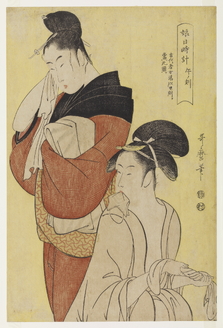
This ukiyo-e woodblock print depicting a woman was created by Edo-period artist Kitagawa Utamaro. Against a background covered with shiny mica powder, Utamaro has depicted the woman up close from the waist up, with special attention paid to her facial expressions. The physiognomy mentioned in the title refers to the study and assessment of a person's character based on looks and so on. The 'Ten Physiognomic Types of Women' is a series that depicts the ten different types of women as determined by their external appearance. It suggests we can tell what someone is like inside by observing their facial features or bearing. The artist certainly had confidence in his own abilities and he gave himself the moniker 'Utamaro the physiognomist.' The woman here is clothed in a yukata worn after bathing.
She is glancing at something to the side as she dries her hands. She is openly displaying her shoulders and breast, while hints of a smile flicker across her eyes and mouth, so the object of her gaze seems to be a handsome man. This is Utamaro's depiction of a 'coquettish type' of woman. At that time, the word 'coquettish' had connotations of flirtatiousness or absent-mindedness. This is the kind of woman who could seem adorable to one person but shallow and outrageous to the next. With this ambitious series, Utamaro set himself the task not only of drawing beautiful women but also of expressing their inner selves. The portraits aim to spark a sense of recognition in the viewer that they too have come across a similar kind of person.
— Museum description: Tokyo National Museum (CC BY 4.0), via ColBase / Japan Search.