Important Cultural Property

Objects excavated presumably in Fukuoka Prefecture
伝福岡県出土品
Archaeological Objects · Heian, 12th centuryNara NM
Home › Browse › Archaeological Objects › Heian period › Objects excavated presumably in Fukuoka Prefecture
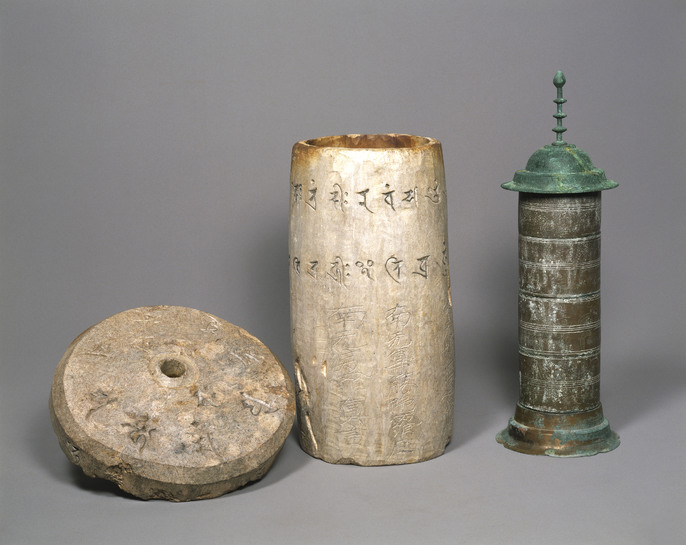
{i=>[Lotus Sutra, Saddharmapuṇḍarīka-sūtra, Fahua jing, Hoke kyō, Sanskrit seed syllables, bīja, shuji, Namu myōhō renge kyō, Lotus Sutra], content=>[There is a finial rising from a parasol-shaped lid on the pagoda-shaped inner sutra container, which has the forms of the deities who protect the , (Skt. , ; Ch. , ; J. , ) inscribed— Fugen (Skt. Samantabhadra) and the Ten Protective Demonesses (Skt. Rākṣasīs; J. Jūrasetsunyo). The outer container is made from talc, and it has the , (Skt. , ; J. , ) of the Lotus Sutra Mandala, the sutra’s mantra, , (“Homage to the , ”), and various other prayers carved into its surface. This is one of the most exquisite sets of objects that has been excavated from a sutra mound.]} {br=>[[], []], content=>[ This sutra case consists of the body part, which is made of four cylindrical sections, the double-layered base part, whose bottom is made in the shape of a flower with six petals, and a lid, which was made in the shape of a bowl which has a sōrin-spire attached to it. The four cylindrical parts of the body are stacked to form a long cylinder. Seven sets of four of five lines are carved along the circumference of the body, and the images of Buddhist deities introduced in the chapter \Darani-bon\ in the Hoke-kyō (Lotus sutra), such as Fugen-bosatsu (Samantabhadra), the ten Rasetsunyo (Rākṣasīs), the two Bosatsu (Boddhisattvas) known as Yakuō-bosatsu and Yuse-bosatsu, and two guardian deities known as Jikoku-ten (Dhṛtarāṣṭra) and Bishamon-ten (Vaiśravaṇa), are depicted with flowing carved lines.
The names of the monks, who were the donators of these objects, and the date of production are also engraved., The talc outer case, in which the above-mentioned sutra case was placed, consists of a body and a lid in the shape of a slightly convex disk. The Hokke Mandala and seven magic words in Sanskrit symbols are engraved into the top of the lid and on the surface of the body., Although no details are known except for the fact that these objects are said to have been excavated in Fukuoka prefecture, both the sutra container and the cylindrical case are extant and they are both excellent works of great dignity befitting the containers of the singnificant Hoke-kyō sutra.]}
— Museum description: Nara National Museum (CC BY 4.0), via ColBase / Japan Search.


