Important Cultural Property
Buddha with Two Attendants
如来三尊立像
Sculpture · Asuka, 6th centuryTNM
Home › Browse › Sculpture › Asuka period › Bodhisattva
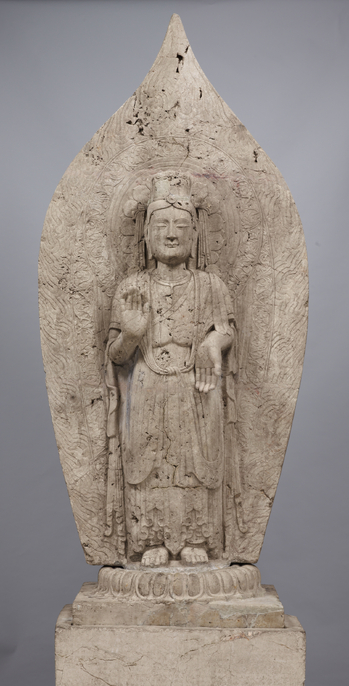
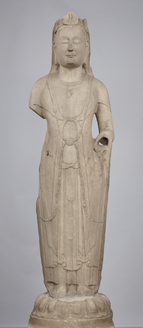
The inscription on the front side of the pedestal notes that this sculpture was created in prayer for peace and prosperity of the first emperor and successive imperial members of the Northern Qi. This large limestone statue is of a standing bodhisattva. The top of the bodhisattva’s head reaches 180 centimetres high, while the statue as a whole, from the bottom of the pedestal to the tip of the halo, is a total of 257 centimetres tall. The halo and figure were both carved from the same piece of stone, while the pedestal was carved from a separate piece. The long face and large hands, and the essentially symmetrical carving of the bodhisattva’s garments, are all elements from 5th to early 6th century Chinese sculpture of the Northern and Southern dynasties period. The tranquil expression on the bodhisattva’s face is characteristic of sculptures made in the Northern Qi dynasty.
On the sides and back of the halo can be found multiple tiny relief carvings of the seated Buddha. An inscription of more than 2000 characters was carved into the four sides of the pedestal, but the majority of the inscription is what is known as a kechi-en. They were a means of making a karmic connection with the Buddha, by carving the names of those who were involved in the production of this sculpture. The front-facing side records that the sculpture was placed in what is now Zhangzi County in the province of Shanxi. It also states that the sculpture and the Buddha reliefs on the halo were carved in 552. The sculpture was meant as an offering from the Zhangzi County governor, his wife and other family, and from the local people, to pray for the longevity of Northern Qi dynasty emperor Wenxuan and his Grand Empress Dowager, and for the well-being of the people.
— Museum description: Tokyo National Museum (CC BY 4.0), via ColBase / Japan Search.