National Treasure

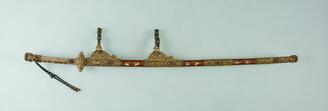
"Tachi" Sword, Known as “Dojikiri Yasutsuna”
太刀 銘 安綱(名物 童子切安綱)
Swords & Armour · Heian, 901–1200TNM
Home › Browse › Swords & Armour › Heian period › Blade for a Long Sword ("Tachi")

The basic shape of Japanese swords was perfected around the 12th century and has remained unchanged ever since. Swords with long blades characteristically curve up from the section where the blade is attached. This curvature was original born of practical reasons, but lean, aesthetically-pleasing curves eventually became an object of appreciation. This tachi long sword dates back to the 12th century. Its pronounced curve is a characteristic feature of swords from that era. The hamon is the intricate, complex line-like pattern that sits gleaming between the dark ground metal and the white blade edge. This sword has a small, irregular hamon pattern. This is commonly seen in swords produced at the end of the Heian period. This sword was made by Tomonari, a swordsmith from modern-day Okayama Prefecture.
A number of swordsmiths and sword schools emerged from this region from the 12th to the 16th centuries. The area flourished as Japan's main sword-producing hub. Tomonari is known as one of the earliest swordsmiths to emerge from Okayama Prefecture. This sword was passed down carefully through the centuries before being gifted to Tokyo National Museum by Yamamoto Tatsuro, one of Japan's foremost scholars of Asian history. In Japan, blades signed by master swordsmiths are considered especially valuable. The maker of this blade, Tomonari, lived over 800 years ago and was among the first swordsmiths to sign his work. A close look at the tang (the part to which the grip is attached) reveals his signature engraved into the steel.
— Museum description: Tokyo National Museum (CC BY 4.0), via ColBase / Japan Search.