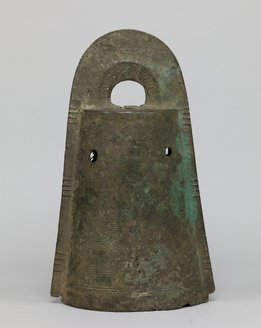
National Treasure
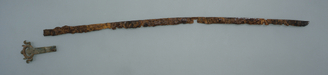
Sword with an Inscription and a Ring Pommel
金象嵌銘環頭大刀
Archaeological Objects · Kofun, 301–400TNM
Home › Browse › Archaeological Objects › Yayoi period › Bell ("Dōtaku")
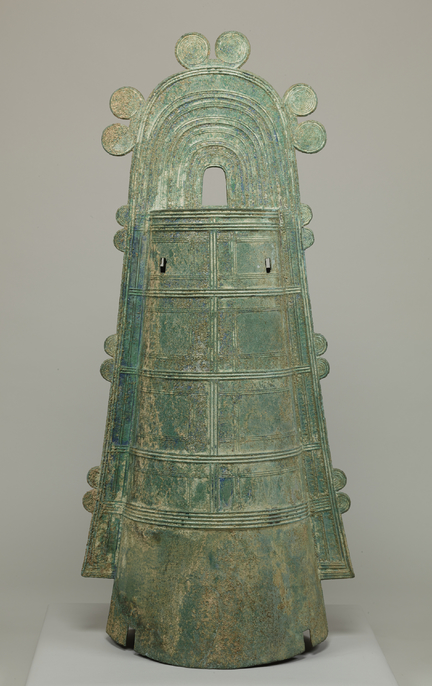
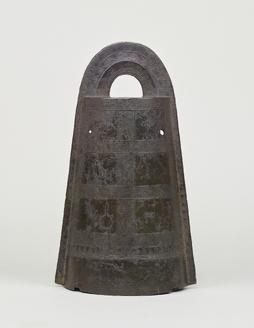
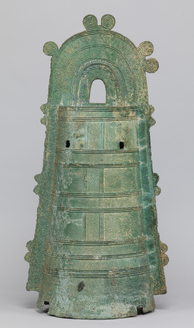
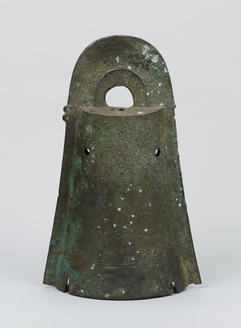
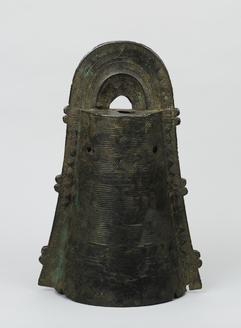
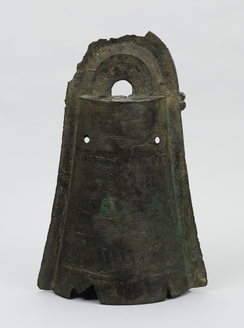
[Dotaku] became increasingly large over time, eventually losing their function as bells. This highly decorative [dotaku] is the largest of its kind in Japan. Dotaku are ceremonial bell-shaped bronzes. They were transmitted to Japan around the 3rd century BC from China and the Korean peninsula. Bronze is an alloy consisting mainly of copper and tin. This dotaku has turned a bluish-green color due to rust, but it originally shone in brilliant gold. Early dotaku were only a few dozen centimeters in length. It is thought they were hung from a cord tied to the handle. A clapper made of wood or animal horn was suspended inside the dotaku to produce a chiming sound when shook. That is why some dotaku bear the marks of where the clapper has struck the inner surface.
As time passed, dotaku became larger in scale. They also grew more decorative and gradually lost their function as objects to be rung. These changes are said to mark the transition from 'dotaku to hear' to 'dotaku to see.' This example belongs to the most recent development stage. It is 134.7 centimeters high and weighs 45.47 kilograms, making it the largest extant Japanese dotaku. Despite the large size, the handle is wide, thin and adorned with decorations. It was probably used for ceremonial purpose as a 'dotaku to see' rather than for any practical purposes. It is thought that dotaku were buried toward the end of the Yayoi period after they lost their ceremonial functions.
— Museum description: Tokyo National Museum (CC BY 4.0), via ColBase / Japan Search.